
Define what the contest rewards
CostumeCrown creates an editable judging sheet with custom criteria, percentage weights, judge counts and ranked results. It is useful when a host wants to explain how marks become a final score rather than rely on an unexplained overall impression.
Write criteria that match the actual creative task. Craft, interpretation and presentation are different questions, and a strong rubric explains each before entrants begin. Do not let budget, popularity or willingness to perform become hidden criteria. A quiet written explanation can be a valid participation route if the contest announces it clearly.
Build a balanced score sheet
Enter criterion names separated by commas, unique contestant names on separate lines, a matching comma-separated weight list and a whole judge count from 1–20. The current weights field retains its three-part label, but the engine accepts 1–8 unique criteria when their count matches the weights. All weights must be nonnegative and total exactly one hundred.
The planner limits total score cells to twenty thousand so large combinations of entrants, judges and criteria are refused before creating an unwieldy sheet. Duplicate names and duplicate criterion labels are rejected without regard to case. Resolve accidental duplicates rather than changing capitalization to make them look distinct.
How the ranking is calculated
After creating the sheet, each judge enters a 0–10 mark for every criterion and contestant. A weighted judge total adds mark × weight/100 across the criteria. The final score is the average of those weighted totals across judges. It stays on a ten-point scale; the weights are percentages, not a request for marks out of one hundred.
Blank required marks are not silently treated as zero. Complete the sheet, verify it and use Calculate rankings. Equal final scores share the same competition rank: two first places are followed by third. The tool does not apply an extra secret tie-break, discard extreme judges or normalize one judge’s stricter scoring.
Fictional example: a shared first place
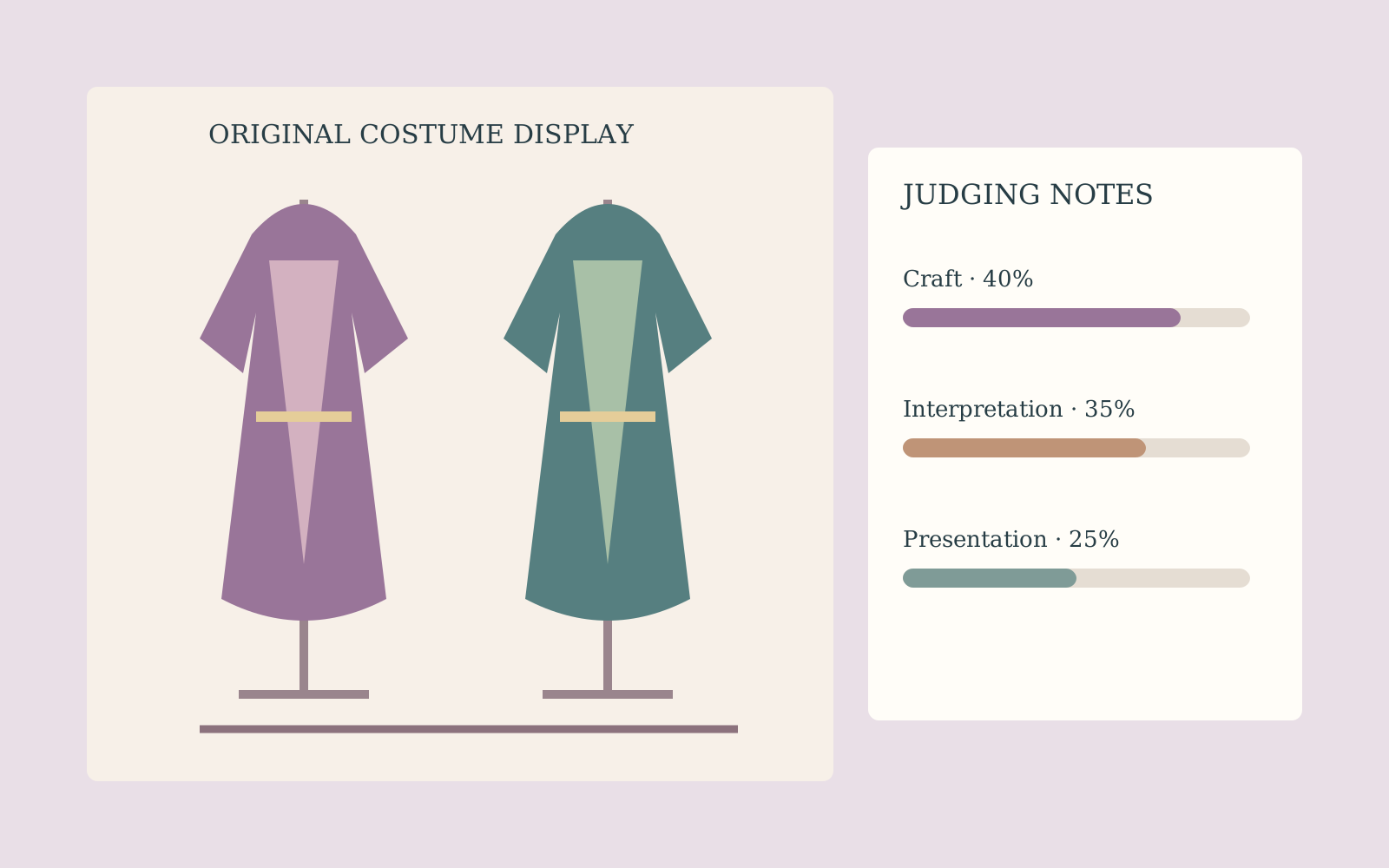
Enter Ari, Bea and Cleo, with Craft, Interpretation and Presentation weighted 40, 35 and 25, and two judges. Ari receives 8, 6, 10 from judge one and 6, 8, 8 from judge two. The weighted totals are 7.8 and 7.2, so Ari’s final score is 7.5.
Give Bea 7.5 on every criterion from both judges: the result is also 7.5. Give Cleo 6 on all six marks: the result is 6.0. After completing all eighteen score cells and calculating, Ari and Bea share rank 1 while Cleo is rank 3. Display order between the two tied names does not choose a winner.
The host checks the entered marks against the original sheets and announces shared recognition, consistent with the published policy. If a real event requires one winner, agree an appropriate deciding procedure beforehand; the current tool does not create a playoff or resolve a tie by silently favoring Craft. All figures here are invented demonstration marks.
| Entrant | Judge 1 total | Judge 2 total | Final | Rank |
|---|---|---|---|---|
| Ari | 7.8 | 7.2 | 7.5 | 1 |
| Bea | 7.5 | 7.5 | 7.5 | 1 |
| Cleo | 6 | 6 | 6 | 3 |
Make a score something you can explain
Use a short written description of what a low, middle and high mark mean for each criterion. Brief judges with the same examples and clarify conflicts of interest outside the calculator. Keep the award announcement separate from photography permission or any claim about rights in the costume design.
Correct transcription errors before publishing results, and save the verified version with a backup. Changing the criteria or weights after entries have been judged changes the contest itself, even if recalculation is easy. CostumeCrown records and computes your marks; it cannot assess originality, detect copied designs, verify licenses or determine whether a judge was fair. Those are human review tasks.
Questions before you begin
Do all judges need to score every criterion?
Yes. The current calculation requires a complete sheet for each entrant. A missing judge or blank criterion is not an automatic zero.
Can weights total ninety-nine because of rounding?
No. They must total one hundred. Choose a clear percentage split before creating the sheet.
Why is the next place third after two firsts?
Ranks count how many entrants have a strictly higher final score. Two tied leaders occupy the first two positions and the next rank is three.
Can I use this for an unjudged public vote?
The tool is designed for weighted judge marks. A simple vote count is a different measure; do not call popularity votes the same score without a published rule.