
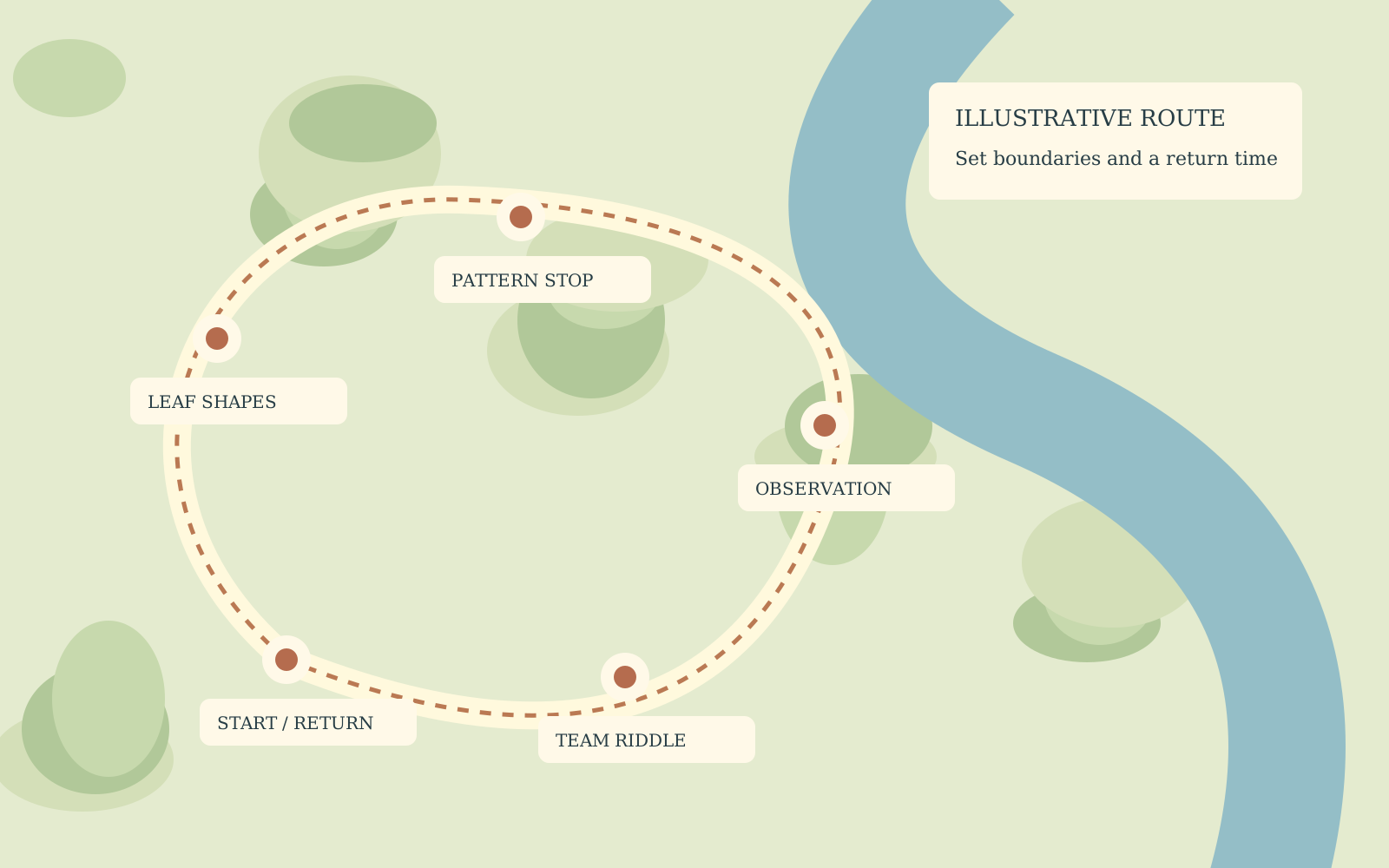
Design the boundary before the hunt
HuntTrail prepares a scavenger-style task board for a permitted venue. You supply locations or tasks, team names, acceptable evidence and a boundary/return rule. It is useful when the group needs equal opportunities to attempt a shared set of observations or puzzles.
The tool is not a map service and does not discover safe places to hide objects. Confirm the usable area first, including which doors, displays and paths are outside the game. An observation, sketch or host signature can make a complete task without requiring collection, a camera or access to private belongings.
Write tasks that tell people what to do
Enter common event details, then one location/task per line. A useful line combines a recognizable permitted point with an action: Host table: count the printed triangles. Add distinct team names, a description of accepted proof and a boundary/return rule. Keep those instructions short enough to repeat at the briefing.
Guest count informs the general plan, but this form does not distribute individual named guests into teams. The team-name list determines the task-board rows. Arrange actual membership separately and ensure a team can complete each task without depending on a private device, physical ability or unannounced outside knowledge.
Read the rotated board accurately
Every team receives every task once. Starting order rotates by one task for successive teams. This can spread arrivals across starting points, but it is not a distance calculation, queue prediction or guarantee that teams never meet. Check that each rotated order is physically sensible within your boundary.
Each team-task record is worth ten points. The host records an evidence note before marking Verified complete. The displayed verified-points total combines completed records across the board rather than producing a separate live league table. There is no photo-upload service, GPS check-in or automatic judgment of a written answer. Proof is a standard that you announce and apply.
Fictional example: three teams, four host-placed tasks
For twelve guests and 100 minutes from 14:00, enter teams Amber, Sage and Ink. Use four tasks: Entrance card: copy the welcome symbol; Display desk: count printed triangles; Reading table: solve the supplied word card; Return desk: write a team motto. Accepted proof is a written response with host initials, and the boundary is the booked room only.
The board has twelve records: three teams multiplied by four tasks. Amber begins at task one, Sage at task two and Ink at task three; each continues cyclically until all four are listed. Each team has forty available points, and the full board has 120. A checked first record contributes ten to the combined total only after its evidence note is present.
The base schedule has five twenty-minute phases and ends at 15:40. It includes permission, team briefing, station visits, proof review and closing, but does not reserve twenty minutes separately for every task. The host checks actual walking and reading time in a rehearsal. All props are labelled event materials; public books and personal items remain outside the hunt.
Make the finish as clear as the start
Choose one return point and a real host signal. Tell teams what to do if a station is unavailable, a clue is damaged or someone wants to leave the activity. A rotated list should not send people through an unsuitable area simply to preserve the generated order.
Do not encourage trespass, picking plants, wildlife disturbance, property damage or approaching roads and water edges. Keep photos optional and obtain relevant permission before any are taken or shared. Use the evidence field to describe what was verified rather than collecting unnecessary personal information. Save the reviewed board and keep a paper version when it is easier for helpers to use on site.
Questions before you begin
Will every team receive the full task set?
Yes. HuntTrail creates a record for every team/task combination. This differs from tools that assign each mission only once across teams.
Does rotating the order guarantee no queues?
No. It changes starting order, not walking time or station capacity. Rehearse the route and adjust the real hosting plan.
Can players upload photographs as proof?
No upload feature is provided. The proof field states your rule and the host records an evidence note. Written answers or signatures can work without photos.
Does a completion checkbox know the answer is correct?
No. It requires an evidence note, then records the host’s verification. Apply the same announced standard to every team.