
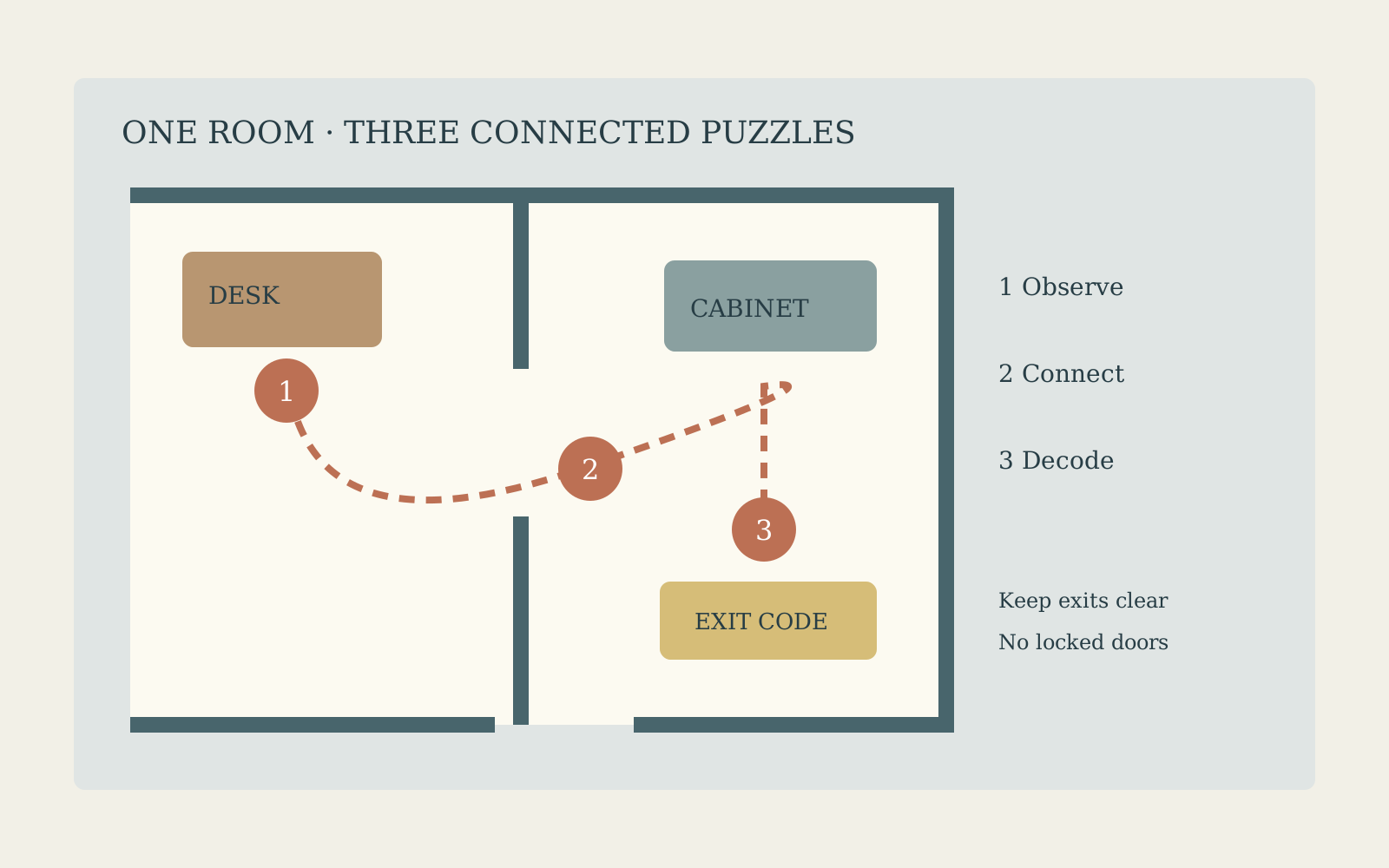
Use fictional locks, not locked exits
EscapeWeave builds a host-run puzzle chain or branching room challenge. It records task dependencies, expected answers, hints, points and a countdown. The attraction is a clear unlock structure: solving an earlier task changes whether a later one can be verified.
The “escape” belongs to the story. Real doors, emergency routes, breaks and access to help must remain independent of progress. Use paper locks or host-held envelopes instead of dangerous mechanisms. The planner is useful for a rehearsed group activity, not a physical containment system or a professional safety assessment.
Write the task graph explicitly
Set theme, guests, budget, duration, start and venue. Each node line uses id | puzzle | prerequisites | answer | hint | points. Opening nodes have an empty prerequisite field. Later nodes reference earlier IDs, with commas separating multiple dependencies. Add team names, a time-limit rule and completion marker.
Every node needs a unique ID, puzzle label and expected answer. The graph rejects missing dependencies and cycles, but does not prove that the puzzle is fair or that the answer can be discovered from the supplied material. Prepare those materials and test the explanation separately. A task can depend on two branches even if it appears earlier in the text than one of them.
Use the host controls in rehearsal
In the result’s progress section, enter an answer and choose Verify. Comparison ignores surrounding spaces and capitalization, but not arbitrary synonyms. Every prerequisite must be complete before a node is accepted. Completion means all nodes verified; the listed points are not an independent automatic win threshold.
The shared countdown can start/resume, pause and reset. When time expires, a message asks the host to apply the stated rule. It does not automatically end input, reveal every answer or allocate hint penalties. Team names do not create individual device sessions or separate saved progress. One browser result holds one host-controlled graph.
Fictional example: two desks opening one archive
For ten guests, set seventy-five minutes from 16:00 and teams Ink and Brass. Enter three nodes on separate lines: numbers | Add 9 and 8 | | 17 | Combine the numbers | 10; letters | Reverse TSUD | | DUST | Read backward | 10; archive | Enter OPEN after both desks report | numbers,letters | OPEN | Both opening nodes are required | 20.
Numbers and letters are available from the start. Nine plus eight gives 17; reversing T-S-U-D produces D-U-S-T. The archive requires both completion flags. Entering OPEN before those verifications is refused even though the final answer is known. Once both desks are complete, OPEN finishes the graph. The three point values total forty.
The host can offer the two opening tasks simultaneously on paper while retaining one shared browser record. The base five-phase outline uses fifteen-minute blocks, ending at 17:15. The seventy-five-minute countdown is an overall game aid, not proof that setup, briefing and play each receive the right amount of real time.
Plan hints and the ending before play
Rehearse a wrong answer, an early final answer and a successful run. Ask a tester to explain how each answer follows from the clue. Give hints that identify a useful next step instead of introducing new essential information that should have been present all along.
State what happens at the limit: a shared explanation, a paused game or optional continued solving. Keep all exits visible and avoid props that could trap, cut or startle participants. The full host result contains entered answers and hints, so do not project it as a player screen. Save reviewed progress and back up the host copy carefully; a complete export is not a private participant packet.
Questions before you begin
Can the two opening tasks run in parallel?
Yes. Leave both prerequisite fields empty, then name both IDs in the final node. The final verification waits for both.
Does a valid graph mean every puzzle has a good solution?
No. Structural validation catches missing references and cycles. The host must test the actual clue wording and supplied materials.
Will the timer lock the room or stop the controls?
No. It shows time and an expiry message. Physical access must never depend on the game, and the host manages the ending.
Can separate teams compete with independent timers here?
Not within one result. It contains a shared progress state and countdown, rather than a multi-team online competition platform.